Malaria cases are on the rise. In 2023, 263 million malaria cases were reported globally and 600,000 deaths (WHO, 2024). Malaria, a parasite is transmitted by mosquitoes, can be vectored by a variety of mosquito species (see Blanford (2024, 2025) and the short video lecture by Blanford (2024 – vector-borne diseases: the malaria example).
Mapping where malaria cases are occurring as captured by the Malaria Atlas Project (map) in the map below provides insights of where malaria is distributed.
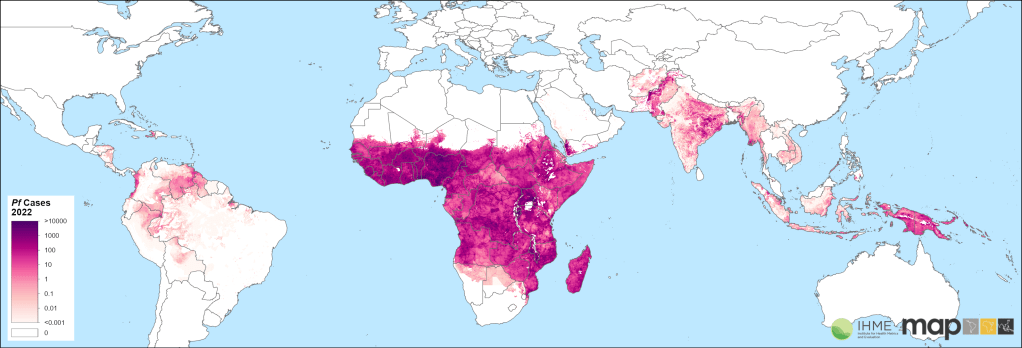
When viewed over time, in the animation below, it becomes clear how the distribution and intensity of malaria cases are changing across Africa between 2000 and 2020.
To combat diseases such as malaria, geospatial data and technologies play a vital role in understanding where the disease is distributed. These can then be used to
- develop intervention strategies
- target interventions
- monitor change in distribution of malaria over time
- assess success of intervention
Sources:
- Blanford, 2024. Managing vector-borne diseases in a geoAI-enabled society. Malaria as an example. Acta Tropica
- Blanford, 2025. Geographic Information, Geospatial Technologies and Spatial Data Science for Health
- Venkatesan, P. (2024) The 2023 WHO World Malaria Report. https://www.thelancet.com/journals/lanmic/article/PIIS2666-5247%2824%2900016-8/fulltext
- WHO (2024) World Malaria Report 2023. https://www.who.int/publications/i/item/9789240086173

 GeoSpatialSense