As summer slowly approaches and one starts to think about the garden and the plants to select for the garden, an important consideration is temperature. Depending on where you live, you will want to select a proportion of plants that will survive from one year to the next, otherwise you will constantly be replacing plants, which can get rather expensive!
Although a variety of factors are important for determining what plants to put where, such as soil type, sunlight (direct vs indirect) and rainfall, temperature and in particular minimum temperature is critical for their year to year survival.
Several plant hardiness zones have been developed. In the US, the USDA has created a plant hardiness zone based on average annual extreme minimum winter temperatures, while in Canada they use the USDA criteria with a variety of additional inputs including mean monthly minimum temperature for the coldest month.
Using the temperature classifications defined by the USDA we wanted to see if we could create a global plant hardiness zone map. To create the map we used monthly minimum temperatures for 2020. Data was combined to create an average annual minimum temperature map which was then reclassified into the 26 zones defined by the USDA. Essentially using a suitability mapping approach where 26 zones are defined delineating suitability for particular plant species.
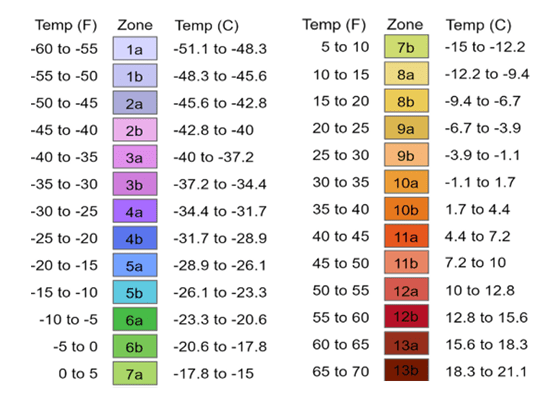
Remember this map is based on average temperatures for 2020 so will not captures the extreme temperatures that can occur from year to year. For the map we displayed 13 zones where each zone includes the subzones a and b. For example, zone 1 contains zone 1a and zone 1b.
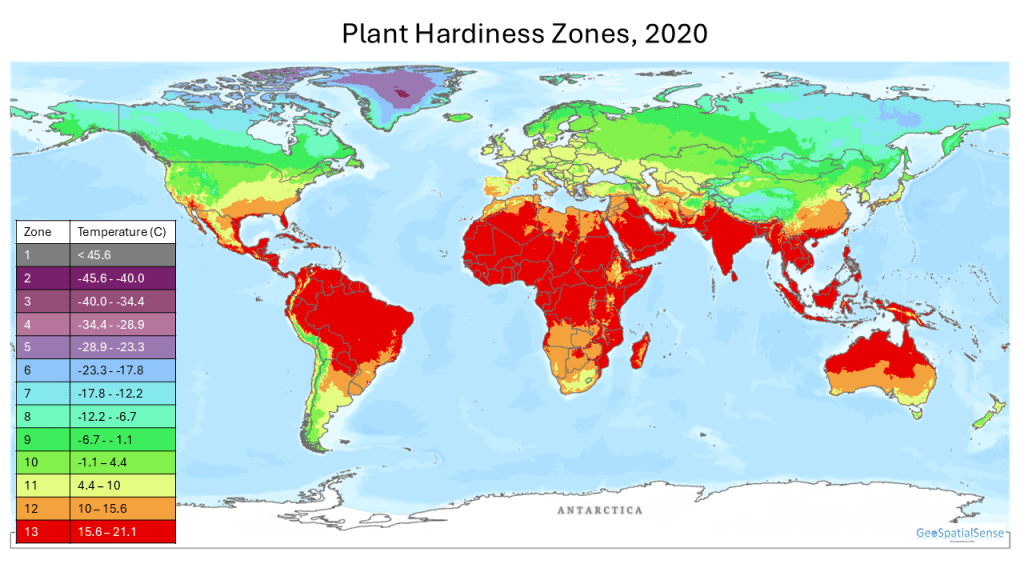
Remember the data used here is for 1 year. Now compare this map with the USDA Hardiness Zone map and the Canadian Hardiness zone map that takes many other factors into consideration. Use the above map with caution as there are quite some differences! In fact the map above needs some further refinements, notably that extreme minimum temperatures are needed rather than annual mean minimum temperatures used here. Back to the drawing board to refine and correct this map.
For the regional plant hardiness zone maps for the US and Canada see below.
US Hardiness Zone
The map is based on the average annual extreme minimum winter temperature, displayed as 10-degree F zones and 5-degree F half zones.

Source: USDA-ARS and Oregon State University (OSU) – https://planthardiness.ars.usda.gov/system/files/National_Map_HZ_36x24_300.jpg, Public Domain, https://commons.wikimedia.org/w/index.php?curid=141009974
Canadian Hardiness Zones
The Canadian Plant Hardiness zones map (McKenney et al, 2001) was developed by mapping a plant hardiness or suitability index, originally developed by Oullet and Sherk, (1967a,b,c).
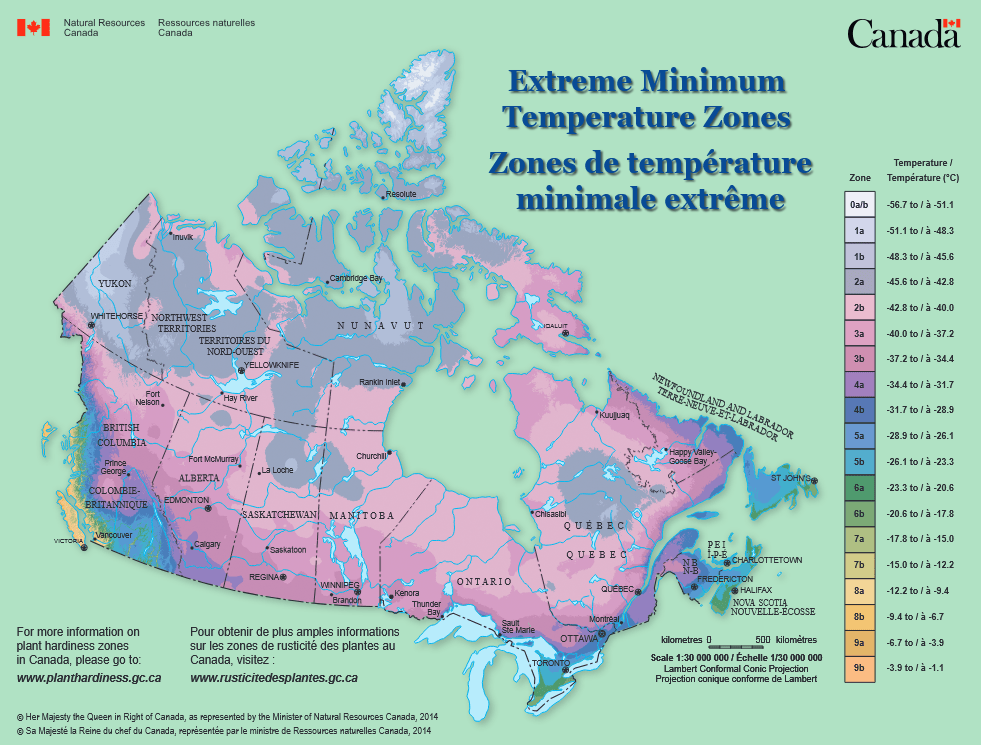
Source: https://planthardiness.gc.ca/images/PHZ_2014_USDA_Map_30M.pdf; https://planthardiness.gc.ca/?m=1
Sources:
- Canada Natural Resources (2014) Extreme Minimum Temperature Zones / Zones de température minimale extrême. https://planthardiness.gc.ca/images/PHZ_2014_USDA_Map_30M.pdf
- Daly, C., M.P. Widrlechner, M.D. Halbleib, J.I. Smith, and W.P. Gibson. 2012. Development of a new USDA Plant Hardiness Zone Map for the United States. Journal of Applied Meteorology and Climatology, 51: 242-264.
- Fick, S.E. and R.J. Hijmans, 2017. WorldClim 2: new 1km spatial resolution climate surfaces for global land areas. International Journal of Climatology 37 (12): 4302-4315.
- McKenney, D. W., Pia Papadopol, M. H., Campbell, K., & Lawrence, K. (2006). The generation of USDA-equivalent extreme minimum temperature models and a comparison with Canada’s plant hardiness zones. Canadian Journal of Plant Science, 86(2), 511-523.
- Ouellet, C.E., Sherk, L.C. 1967a. Woody ornamental plant zonation I. Indices of winter hardiness. Can J. Plant Sci. 47: 231-238.
- Ouellet, C.E., Sherk, L.C. 1967b. Woody ornamental plant zonation. II. Suitability indices of localities. Can J. Plant Sci. 47: 339-349.
- Ouellet, C.E., Sherk, L.C. 1967c. Woody ornamental plant zonation III. Suitability map for the probable winter survival of ornamental trees and shrubs. Can J. Plant Sci. 47: 351-358.
- USDA Plant Hardiness Zone Map, 2023. Agricultural Research Service, U.S. Department of Agriculture. Accessed from https://planthardiness.ars.usda.gov/
- Widrlechner, M.P., C. Daly, M. Keller, and K. Kaplan. 2012. Horticultural Applications of a Newly Revised USDA Plant Hardiness Zone Map. HortTechnology, 22: 6-19.
- Worldclim. https://www.worldclim.org/
© 2023-present GeoSpatialSense. All Rights Reserved

 GeoSpatialSense